soj.ooO
BETA
The social discussion platform
Home
Pochas
Channels
Videos
Log in
Sign up
Sign up
Home
Pochas
Channels
Videos
Log in
Sign up
Parent Post: India Pakistan
rick
·
6/3/2025, 1:28:26 PM
·
permalink
%%Courtesy of @hyokkim%% Why India’s Arjun Tank Program Failed Miserably November 18, 2021 By: Kyle Mizokami 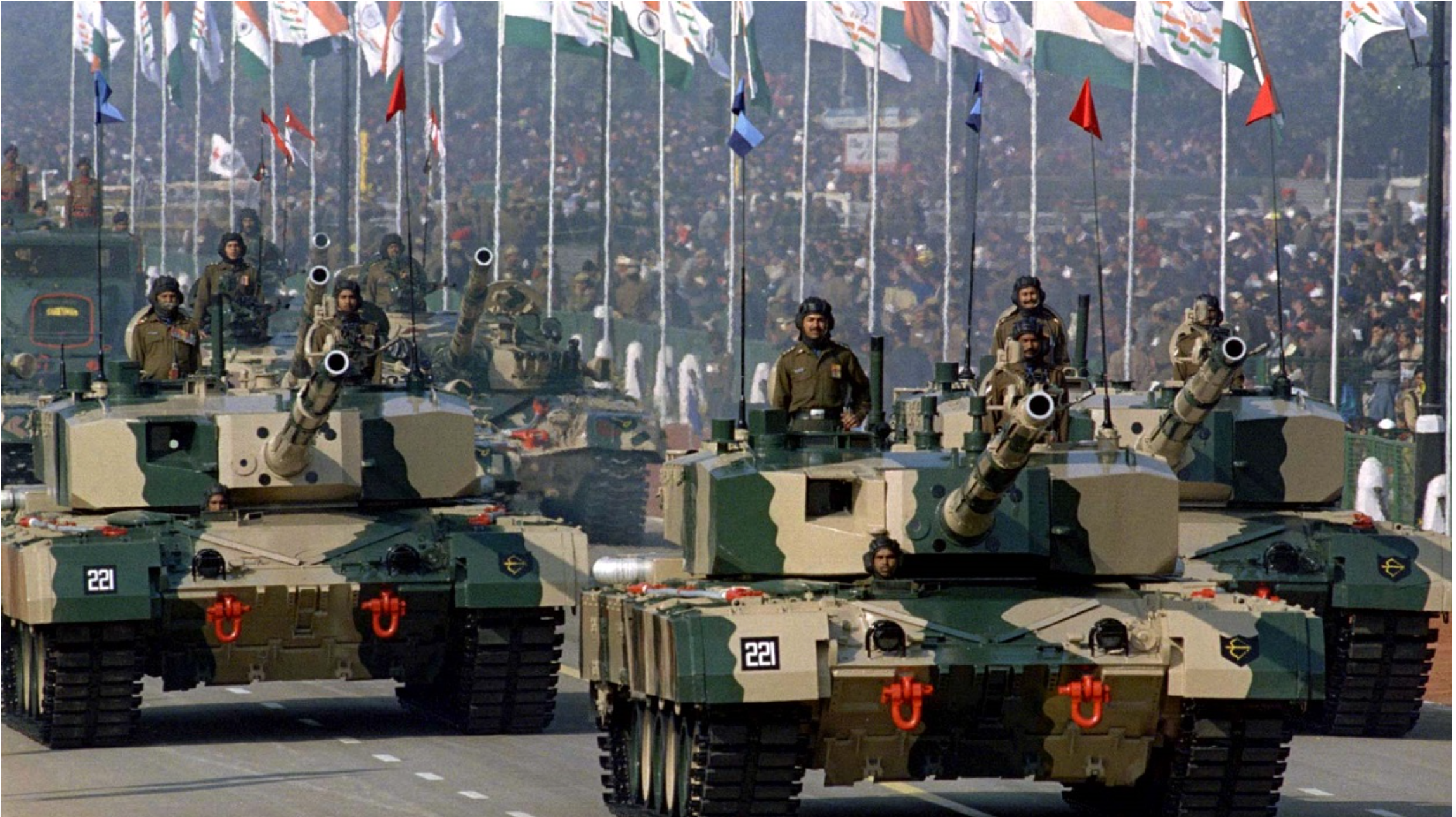 Why India’s Arjun Tank Program Failed Miserably November 18, 2021 By: Kyle Mizokami Here’s What You Need to Know: The Indian Army was forced to buy 124 Arjuns—enough to equip just two armored regiments—to keep state tank production facilities open. By mid-2015, two years after the purchase was complete, nearly 75 percent of the Arjun force was inoperable. In the mid-1970s, India began development on a totally new, advanced main battle tank that would satisfy the needs of the country’s Armored Corps. An impressive combination of firepower, armor protection and mobility, the tank was to be India’s first indigenously produced tank—and one of the best in the world. The service date for the tank, known as Arjun, was confidently set for 1985. Instead, the Arjun suffered a tortuously long development period spanning two centuries. The final result, introduced into the army twenty-six years later than originally planned, is a mess of a tank that not even the Indian Army wants. The Indian Army’s Armored Corps has been in existence for seventy-four years, tracing its roots to the Second World War, and has fought in every one of India’s wars with neighbor and rival Pakistan. The Corps has across has sixty-three armored regiments (the equivalent of battalions), spread across eight armored and mechanized divisions and another seven armored and mechanized brigades. The decision to produce an indigenous Indian tank was made in 1972, shortly after the Indo-Pakistani War of 1971. In 1974, the state-run Defence Research and Development Organisation (DRDO) was tasked with developing the tank. It was to be a forty-ton vehicle, armed with a 105-millimeter gun. It would be small enough to be strategically mobile, capable of being shuttled on internal lines (roads and railroads) to vital sectors along the long border with Pakistan. DRDO decided to make the tank, called Arjun, a mostly Indian design. The Combat Vehicles Research and Development Establishment, part of DRDO, was to design the hull, armor, turret, gun and running gear. The main gun and engine would be imported. Unfortunately, India’s defense-industrial base was nowhere near capable of creating such a vehicle. As if that weren’t enough of an obstacle, India’s world-famous bureaucracy and red-tape machine was another enemy to progress. Today, the Arjun Mk 1 is a sixty-two-ton tank, complete with a 120-millimeter gun, advanced composite armor, a 1,400-horsepower turbocharged engine, and advanced fire control and thermal sights. Although the tank’s specifications are impressive, the actual product leaves a lot to be desired. By 2009, thirty-five years after it was originally conceived, Arjun was “ready” for production. Despite shortcomings revealed in testing, the Indian Army was forced to buy 124 Arjuns—enough to equip just two armored regiments—to keep state tank production facilities open. By mid-2015, two years after the purchase was complete, nearly 75 percent of the Arjun force was inoperable due to technical problems. Arjun’s armored protection evolved significantly over thirty-five years. The tank is fitted with Kanchan armor, a locally designed composite blend that is allegedly similar to British Chobham armor. Kanchan is rumored to be capable of shrugging off point-blank shots from the 125-millimeter gun of Indian T-72 tanks. Arjun is so well protected that its weight ballooned from the original forty-ton specification to sixty-two tons. https://nationalinterest.org/blog/reboot/why-indias-arjun-tank-program-failed-miserably-196467
Save
Cancel
2
bumps
Share
rick
·
6/3/2025, 1:31:49 PM
·
permalink
Courtesy of @hyokkim India launches AMCA stealth fighter program amid China and Pakistan tensions By Clement Charpentreau May 27, 2025, 16:09 (UTC +3) 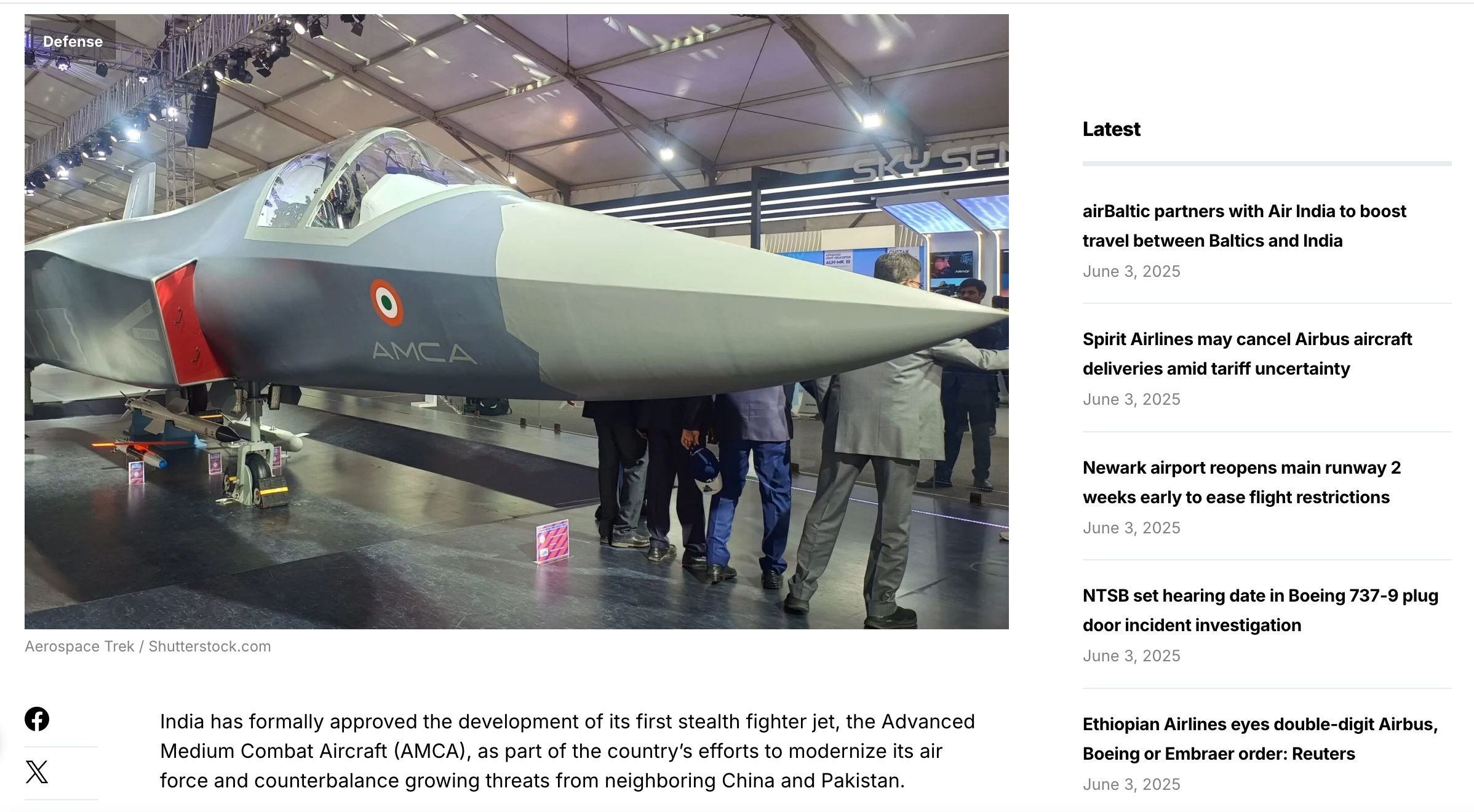 India has formally approved the development of its first stealth fighter jet, the Advanced Medium Combat Aircraft (AMCA), as part of the country’s efforts to modernize its air force and counterbalance growing threats from neighboring China and Pakistan. The announcement, made on May 27, 2025, by India’s Ministry of Defense, comes amid heightened regional tensions and follows weeks of increased friction with Pakistan, including a recent large-scale aerial confrontation that some have called one of the most intense since the Kargil War. While a ceasefire is now in place, both nations appear to be accelerating their military buildup, particularly in drones and advanced air systems. Dassault Rafale of Indian Air Force RELATED Pakistan claims downing of Indian Rafale jets. Here’s what the evidence shows Strategic priorities and industrial shift The AMCA program is considered a top priority for the Indian Air Force (IAF), whose fleet still consists of aging Russian-designed platforms. The aircraft is expected to eventually replace older jets and supplement some of India’s current frontline fighters, including the Tejas, Rafale, and Su-30MKI. Led by a public agency affiliated with the Ministry of Defense, the AMCA program will soon enter its next phase with a formal call for tenders to begin prototype development. In a notable shift, India also intends to involve private and non-HAL public firms in the program, aiming to diversify its defense industrial base beyond Hindustan Aeronautics Limited (HAL), which has faced criticism for delays in Tejas production. India is actively seeking a foreign partner to co-develop a high-thrust engine for the AMCA, with a clear expectation that the system will eventually be produced domestically. Among the frontrunners are France’s Safran, General Electric of the United States, and Rolls-Royce of the United Kingdom. Safran has longstanding ties with India and previously collaborated on the Kaveri engine project. Renewed negotiations have raised hopes of a possible Indo-French engine development partnership, though concrete agreements are still pending. Fifth generation… or more? The AMCA is expected to feature all the characteristics of a fifth-generation fighter: stealth, supermaneuverability, supercruise, advanced networking, and sensor fusion. In that regard, it aims to stand alongside the likes of the F-22 Raptor, F-35 Lightning II, and Su-57 Felon. However, as global defense giants pivot toward sixth-generation fighter programs, such as the US NGAD, Europe’s FCAS and Tempest, and likely efforts in Russia and China, India’s AMCA has found itself straddling a generational gap. Official descriptions of the AMCA have varied over the years. Initially conceived as a fifth-generation platform, the aircraft has since been described by Indian officials, including former Air Chief Marshal R.K.S. Bhadauria, as incorporating “sixth-generation characteristics.” These include optional manned capability, integration with unmanned loyal wingmen, swarming drones, and potentially even hypersonic weapons. India’s interest in manned-unmanned teaming (MUM-T) is already visible in HAL’s Combat Air Teaming System (CATS), unveiled in 2021. The system envisions swarms of drones supporting a manned fighter in complex missions, with the AMCA potentially serving as the central command node. Yet these features, while ambitious, are still in their infancy globally and often exist more in concept than in operational form. The AMCA may incorporate sixth-generation elements during later stages of development or through future upgrades, much like the Rafale or the F-35 are expected to integrate drone teaming capabilities eventually. The AMCA is not expected to enter production before the late 2020s or early 2030s, and its first flight is still several years off. But its launch signals India’s determination to elevate its status as a defense innovator and reduce reliance on foreign suppliers, particularly as global alignments continue to shift. https://www.aerotime.aero/articles/india-launches-amca-stealth-fighter-program-amid-china-and-pakistan-tensions
Save
Cancel
1
bump
Share
Signature
Loading…
Verify locally
Close