soj.ooO
BETA
The social discussion platform
Home
Pochas
Channels
Videos
Log in
Sign up
Sign up
Home
Pochas
Channels
Videos
Log in
Sign up
Parent Post: If Your Going To Attack Iran Arm Your Arab Proxies
rick
·
7/10/2025, 7:58:42 PM
·
permalink
Excerpt. 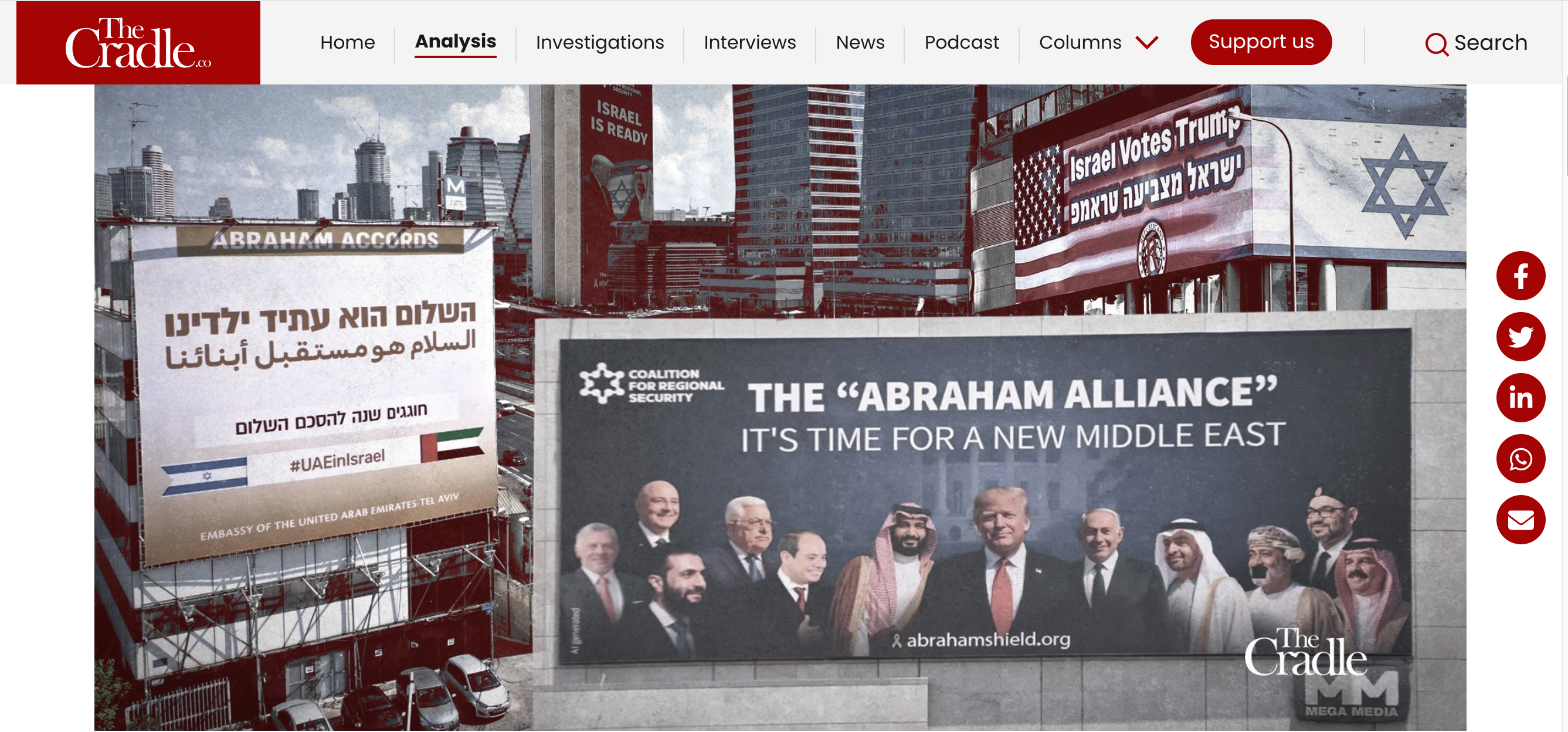 Photo Credit: The Cradle Days after the 12-Day Israel–Iran war, drivers in Tel Aviv were greeted by a colossal digital billboard lined with familiar faces: Persian Gulf royals in pristine robes, Arab presidents in pressed suits, all grouped under a bold banner – The Abraham Alliance. There was no clarification of who had formally signed on, no footnote about “ongoing consultations.” The image made no distinction. The message was clear: Whether officially declared or discreetly aligned, these governments had already enlisted in the occupation state’s regional vision. For years, Arab governments have played both sides – issuing statements of solidarity with Palestine, while coordinating airspace, intelligence, and investments with Tel Aviv. Saudi Arabia repeatedly claims it will not normalize without movement on Palestinian statehood, even as Israeli jets crisscross its skies and business delegations are quietly exchanged. So did the billboard reveal the truth? Or, simply confirm what has long been denied? **The blueprint behind the billboard** It was not a PR stunt. It was the public unveiling of a strategy to turn Gaza into a controlled laboratory, to conscript Arab states into an anti-Iran alliance, and to redraw borders with neither war nor negotiation – just power and complicity. The plan behind this billboard is not a rumor, but a formal policy document drafted in March by more than 100 former Israeli generals, intelligence officials, and diplomats. Dubbed “The Abraham Shield,” its rhetoric of “stability” and “shared prosperity” cloaks a blueprint for expanding the Greater Israel project. In plain terms, the plan institutionalizes apartheid, engineers demographic erasure in Gaza, and repackages Palestine as a pacified enclave ruled by proxy. It lays out six pillars: Gaza’s transformation – eradicating Hamas and installing a foreign-controlled transitional authority backed by external security forces; demilitarization – a decade or more of sealed borders, disarmament, and digital surveillance, turning Gaza into a monitored containment zone; economic reconstruction – tied to a cashless, biometric-controlled economy designed to reward submission and punish dissent; a regional enforcement coalition – the “Abraham Alliance” where Arab states align intelligence and repression efforts with Israel; Syria as a buffer – an explicit plan for southern regime change and an Israeli security corridor to break Syrian sovereignty and contain Iran; Iran containment – a hybrid strategy of sanctions, sabotage, assassinations, and diplomatic isolation to dismantle Iranian regional influence. https://thecradle.co/articles/abraham-shield-Israels-next-big-blitzkrieg
Save
Cancel
4
bumps
Share
rick
·
7/10/2025, 8:09:29 PM
·
permalink
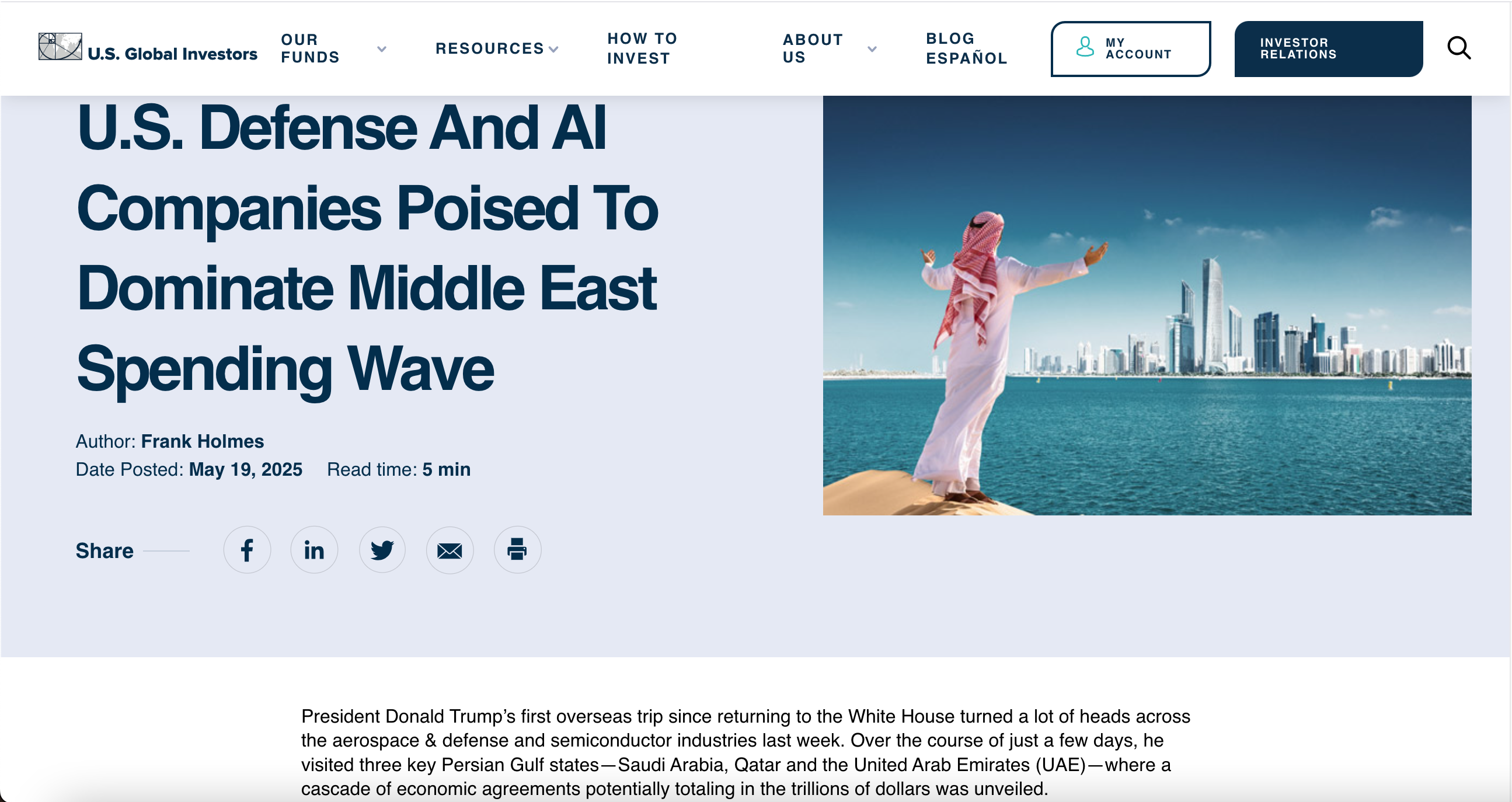 One of the marquee announcements was a $142 billion arms deal, part of a broader $600 billion commercial package between the U.S. and Saudi Arabia. Touted by the White House as the “largest defense sales agreement in history,” the deal includes “state-of-the-art warfighting equipment” and services from more than a dozen American defense companies, though none are named. Saudi Arabia is already the largest U.S. foreign military sales (FMS) customer, with nearly 80% of its defense acquisitions coming from American companies. According to the Stockholm International Peace Research Institute (SIPRI), Saudi Arabia spent more than $80 billion on defense in 2024, making it the seventh-largest military spender in the world and by far the largest in the Middle East. **U.S. Remains Saudi Arabia's Largest Supplier of Arms** The Saudis aren’t alone. The UAE and Qatar have also made substantial defense purchases in recent months, including advanced drones, helicopters and counter-drone systems. As geopolitical uncertainty grows, Gulf nations are doubling down on deterrence, and they’re looking to the U.S. for the tools to do it. **Betting Big on AI Infrastructure and American Semiconductors** One of the more striking takeaways from the trip might be the emergence of AI and semiconductors as critical assets in the defense toolkit. In Saudi Arabia, a new state-backed initiative called HUMAIN is leading a multibillion-dollar push to build an “AI Zone,” in partnership with Amazon Web Services (AWS). The project, which will feature dedicated server farms powered by American semiconductors, is part of a broader effort to localize advanced tech manufacturing and training within the Kingdom. NVIDIA, the world’s leading AI chipmaker, is expected to provide HUMAIN with at least 18,000 of its GB300 Grace Blackwell processors. Over the next five years, that number could reach several hundred thousand chips. Meanwhile, the UAE is negotiating for more than a million NVIDIA chips, enough to radically boost its own AI infrastructure. U.S. AI Stocks Surge on Trump's Middle East Dealmaking Saudi Arabia’s AI investments alone could generate $3 to $5 billion in annual chip sales, with longer-term infrastructure spending estimated at $15 to $20 billion, according to Bank of America analyst Vivek Arya. That would make sovereign AI one of the fastest-growing areas in the broader $450 billion AI infrastructure market. **Aviation Remains a Strategic Pillar** Aviation shouldn’t be overlooked. In Qatar, Boeing signed its largest-ever widebody aircraft deal, a $96 billion order with Qatar Airways for up to 210 American-made jets. Powered by GE Aerospace engines, the order includes both the 787 Dreamliner and 777X platforms. This deal alone underscores the continued strategic value of aerospace as a core pillar of both economic and national security policy. Commercial aircraft deals often include co-production agreements, pilot training and maintenance support—capabilities that enhance soft power while reinforcing the industrial base. **Global Military Spending on a Relentless Uptrend** All of this comes against a backdrop of surging global military budgets. World defense spending hit a record $2.7 trillion in 2024, a 9.4% year-over-year increase and the sharpest rise since at least 1988, according to SIPRI. Spending has risen for 10 consecutive years, with gains across all five global regions. Global Military Spending Hit a New Record High of $2.7 Trillion in 2024 Meanwhile, NATO is moving toward a new target of 5% of GDP for defense spending, up from the longstanding 2% benchmark. Both Germany and the U.S. have endorsed the increase, and the final plan is expected to be unveiled at the NATO summit this June. The world isn’t de-escalating. It’s rearming, with greater urgency, more advanced tools and higher price tags. I see these trends as a growing opportunity across multiple sectors—defense contractors, semiconductor makers, AI infrastructure providers and aerospace manufacturers. While individual names and strategies must be evaluated with care, the broader momentum is unmistakable. https://www.usfunds.com/resource/u-s-defense-and-ai-companies-poised-to-dominate-middle-east-spending-wave/
Save
Cancel
2
bumps
Share
Signature
Loading…
Verify locally
Close