soj.ooO
BETA
The social discussion platform
Home
Pochas
Channels
Videos
Log in
Sign up
Sign up
Home
Pochas
Channels
Videos
Log in
Sign up
lemonhelmet
·
p/philosophy
·
10/1/2026, 1:07:10 PM
random thoughts
79
bumps
36
comments
Share
Comments
Log in to join the conversation
Log in
or
Sign up
lemonhelmet
·
10/1/2026, 1:07:40 PM
·
permalink
The Social Contract as a Shared Story Every civilization rests upon a social contract. This contract is not primarily a legal document or a collection of laws, but an implicit consensus about what is true, what is good, what is just, and what kind of person one ought to become. Laws are merely the outward expression of this deeper agreement. Before a state comes into existence, there must first exist a shared vision of reality. This shared vision does not emerge from a purely rational agreement between individuals. Human beings do not unite around abstract philosophical principles; they unite around stories. Since the earliest civilizations, myths, religion, epics, and sacred texts have shaped collective consciousness far more profoundly than any political manifesto. The reason is psychological. The human mind understands reality through narrative. Archetypal stories are not simply works of literature—they are the frameworks through which we interpret life, suffering, sacrifice, love, responsibility, and meaning. They define what we recognize as virtue and what we condemn as evil. For this reason, every social contract, whether consciously or unconsciously, is informed by a theology or a foundational worldview. That theology does not necessarily have to be religious. It may also be secular or atheistic. Even a society that claims to have no religion still operates according to a set of fundamental assumptions about humanity, reality, and morality that occupy the role religion once held. From theology emerges culture. Culture shapes tradition, customs, art, and the way a people lives. From culture arise politics, laws, and institutions. In other words, laws are not the foundation of society—they are its consequence. When a civilization's worldview changes, its culture eventually changes, followed by its political and legal institutions. In Serbia, until the end of the Second World War, Orthodox Christianity formed the foundation of the social contract. Regardless of an individual's personal level of religious observance, concepts of morality, family life, sacrifice, community, holidays, and historical identity were deeply shaped by the Orthodox worldview. It provided the common archetypal narrative from which people drew both identity and meaning. After the Second World War, that continuity was deliberately interrupted. Religion and philosophy were gradually displaced from public life, and communist ideology took their place. This ideology was not merely a political system; it became the new source of the social contract. It offered its own understanding of history, humanity, good and evil, together with its own heroes, symbols, rituals, and moral vision. Like every comprehensive ideology, it assumed many of the cultural functions that religion had previously fulfilled. At its foundation, however, an atheistic worldview does not derive moral values from a transcendent source. If there is no objective moral reality that exists beyond humanity itself, morality becomes either a matter of social consensus or individual preference. From this perspective, psychological materialism, moral relativism, and nihilism can naturally emerge. Psychological materialism reduces the human person to biological and material processes. Moral relativism dissolves the distinction between objective good and evil, treating morality as dependent upon perspective or personal interest. Within such a framework, it becomes possible to respond to obvious moral wrongdoing with a simple, "So what?" If there is no higher moral authority, consequences become merely practical rather than moral. Nihilism represents the logical conclusion of this process—the belief that life possesses no objective meaning or ultimate purpose. With the collapse of Yugoslavia, the ideology that had served as the common framework of society also disappeared. Yet no new shared foundation emerged to replace it. As a result, contemporary Serbian society exists between two narratives: the traditional narrative has been weakened, while the ideological narrative has disintegrated. The social contract—our shared understanding of values, morality, and the principles upon which society should rest—is no longer firmly anchored. Modern people no longer inhabit a single overarching story. Instead, they consume thousands of competing narratives every day through television, the internet, social media, films, and advertising. Each narrative presents its own vision of success, happiness, identity, family, freedom, and purpose. None is powerful enough to unify society, yet together they generate an endless stream of fragmented meanings. I refer to this condition as fractured reality through narrative. Our understanding of reality no longer arises primarily from lived experience, shared tradition, or inherited culture. Instead, it is increasingly mediated through screens and shaped by countless disconnected stories. Rather than orienting ourselves within a single coherent cultural framework, we navigate a landscape of competing narratives, each pointing toward a different conception of reality. The deepest crisis of our time is therefore not primarily political or economic. It is anthropological and civilizational. It is a crisis of the shared story. A society does not cease to exist when it loses wealth or territory. It begins to dissolve when it can no longer answer the fundamental questions: Who are we? Why do we exist? What values do we wish to pass on to our children? The stability of any civilization depends not only on its economy or military strength but on the strength of the shared narrative that binds its people together. The clearer, deeper, and more widely accepted the social contract is, the more resilient society becomes in the face of crisis, manipulation, and internal division. The clearer its traditions and archetypal stories are, the easier it is to transmit not only those stories themselves but also the values they embody to future generations. Ultimately, the question is not whether a society will live by a story. Every society does. The real question is which story will serve as its foundation, and whether that story is powerful enough to unite a people around a shared understanding of truth, goodness, and meaning.
Save
Cancel
19
bumps
Share
sacredcow
·
10/1/2026, 3:33:41 PM
·
permalink
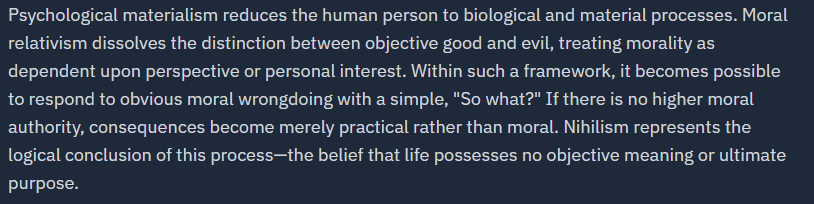 Ultimate purpose? What is your ultimate purpose? Should all humans share your ultimate purpose as well? Did the Native Americans and Tribal peoples of the middle east share a purpose of any kind?
Save
Cancel
16
bumps
Share
sacredcow
·
10/1/2026, 3:36:08 PM
·
permalink
What is a purpose that is ultimate in your opinion? Because you state these things, now they are facts? In your perspective? Or reality? I think you have rose colored glasses on about these evolved monkeys in clothes named humans... But air conditioning was an amazing break through.
Save
Cancel
12
bumps
Share
lemonhelmet
·
10/1/2026, 3:45:41 PM
·
permalink
my framework is philosophical realism. Metalogical realism.
Save
Cancel
10
bumps
Share
sacredcow
·
10/1/2026, 4:17:58 PM
·
permalink
Which philosophy is more real than another? Its humans having opinions about the world they are observing during that time in history. "Metalogical realism" is a great term. Also defining what is real or not real for others. Logic itself defining reality. Your logic and others logic isn't the same. Who's logic then defines reality?
Save
Cancel
9
bumps
Share
lemonhelmet
·
10/1/2026, 4:19:17 PM
·
permalink
What are the 3 laws of logic?
Save
Cancel
8
bumps
Share
sacredcow
·
10/1/2026, 4:39:30 PM
·
permalink
Is a god logical then? Based upon those laws?
Save
Cancel
7
bumps
Share
lemonhelmet
·
10/1/2026, 4:40:13 PM
·
permalink
what are the 3 laws of logic?
Save
Cancel
6
bumps
Share
sacredcow
·
10/1/2026, 4:48:38 PM
·
permalink
Law of Identity, which the idea of a god fails. Law of Non-contradiction, which gods contradict themselves all the time. Law of Excluded Middle, gods entire schtick is that it does everything and nothing. Maybe a smart creator knows to leave the ant farm alone.
Save
Cancel
5
bumps
Share
lemonhelmet
·
10/1/2026, 4:50:39 PM
·
permalink
hahah why would you limit God to human perception? thats not the God i am talking about... he IS logic 😆
Save
Cancel
4
bumps
Share
sacredcow
·
10/1/2026, 5:00:11 PM
·
permalink
I have cow perception, I'm on a higher place of thinking. I'm one step up the ladder of enlightenment.
Save
Cancel
3
bumps
Share
lemonhelmet
·
10/1/2026, 5:24:17 PM
·
permalink
haha ok haha
Save
Cancel
2
bumps
Share
lemonhelmet
·
10/1/2026, 4:00:23 PM
·
permalink
Depending on the framework we adopt, what we unconsciously and consciously believe to be true about reality, we act in the world. The more that framework corresponds to objective reality about the world, the better we are equipped to function... on a societal level and on a personal level, it is beneficial. Example: if your framework tells you you can fly, and you jump off of a building... that's not a good framework
Save
Cancel
1
bump
Share
lemonhelmet
·
10/1/2026, 3:43:43 PM
·
permalink
i am Eastern Orthodox. so i know what my purpose is. The point of what I wrote is this: Do you know your purpose?
Save
Cancel
3
bumps
Share
sacredcow
·
10/1/2026, 3:58:44 PM
·
permalink
So you let something outside of yourself define you? That is why religions come and go so easily, its not what people are, they are just grasping it for a little while. Gods come and go. If there was or is a creator, my purpose would be to define my life. Isn't that what freedom is? Or what your holy book proclaims?
Save
Cancel
2
bumps
Share
lemonhelmet
·
10/1/2026, 4:01:25 PM
(edited)
·
permalink
no. there is no need to define me hahah i just am… My actions define me.
Save
Cancel
1
bump
Share
seraphima
·
10/1/2026, 4:47:33 PM
·
permalink
Brava! This is brilliant. I don't know you yet so..."Welcome!" I'm glad to have such an incredibly smart and thoughtful lady around here giving me something deep to think about. 😁
Save
Cancel
3
bumps
Share
lemonhelmet
·
10/1/2026, 4:54:35 PM
·
permalink
hahha happy to be here. Thank you for the warm welcome
Save
Cancel
2
bumps
Share
sacredcow
·
10/1/2026, 1:59:15 PM
·
permalink
Yes, so many people have let other things define who they are instead of themselves doing it. People feel empty and lost because they let Apple or Chevrolet define them. What myths, fairy tales or sacred stories do you like or learned from?
Save
Cancel
15
bumps
Share
lemonhelmet
·
10/1/2026, 2:00:44 PM
·
permalink
All of them, but the main one is the first literal hyperlink
Save
Cancel
14
bumps
Share
Signature
Loading…
Verify locally
Close