soj.ooO
BETA
The social discussion platform
Home
Pochas
Channels
Videos
Log in
Sign up
Sign up
Home
Pochas
Channels
Videos
Log in
Sign up
Parent Post: "Bannon warns we’re heading towards ‘national suicide’…"
·
In Reply To
rick
·
7/10/2025, 12:10:28 PM
·
permalink
**Military Production Outsourcing** The extent of military production outsourcing in the United States is significant and has evolved over time due to economic, strategic, and industrial factors. The U.S. military has historically relied on a mix of public and private manufacturing for its weapons and ammunition. While government-owned facilities like the Philadelphia Naval Shipyard and Springfield Arsenal played key roles in military production, much of the manufacturing has shifted toward private-sector contracts. This approach leverages the private sector’s ability to achieve economies of scale, as seen with the production of vehicles like the Humvee and small arms like the M4 carbine, which benefit from the broader industrial capacity and expertise of civilian manufacturing. However, this outsourcing model has raised concerns, particularly in times of large-scale conflict when the demand for munitions and equipment surges beyond peacetime capacity. Private companies are often reluctant to invest in infrastructure for short-term military contracts, which can lead to bottlenecks in production. During major conflicts such as World War II, the government had to intervene with subsidies and resource controls to ensure adequate production levels. In recent years, outsourcing has extended beyond manufacturing to include a wide range of services and components, including critical parts sourced from foreign suppliers. The U.S. military’s reliance on Chinese suppliers for certain components has raised alarms among national security experts. This dependence on foreign entities—especially adversaries—has been described as a strategic vulnerability, with the potential to compromise readiness and operational capability. Moreover, the outsourcing of manufacturing has contributed to a decline in domestic industrial capacity. Much of the work related to munitions and defense systems has been offshored, particularly to countries with lower labor costs and fewer regulatory constraints. This shift has been linked to the broader trend of offshoring in the U.S. manufacturing sector, where over 5 million jobs and 91,000 plants have been lost since 1998. The Pentagon has also increasingly relied on private military firms (PMFs) for logistics, maintenance, and even operational support. While outsourcing these functions can reduce costs and improve efficiency, it raises concerns about accountability, oversight, and the potential erosion of core military capabilities. Overall, while outsourcing has provided cost savings and access to industrial expertise, it has also introduced risks related to supply chain security, industrial atrophy, and operational readiness. The U.S. is now undertaking efforts to rebuild domestic manufacturing capacity, particularly in critical areas like semiconductor production and munitions manufacturing, to reduce its reliance on foreign suppliers and ensure it can meet the demands of future conflicts.
Save
Cancel
8
bumps
Share
rick
·
7/10/2025, 12:11:09 PM
·
permalink
"In 1992 a relatively little-known, Texas-based oil services firm called Halliburton was awarded a $3.9 million Pentagon contract. Its task was to write a classified report on how private companies, like itself, could support the logistics of U.S. military deployments into countries with poor infrastructure. Conspiracy theories aside, it is hard to imagine that either the company or the client realized that 15 years later this contract (now called the Logistics Civilian Augmentation Program or LOGCAP) would be worth as much as $150 billion." https://www.brookings.edu/articles/outsourcing-the-fight/
Save
Cancel
6
bumps
Share
rick
·
7/10/2025, 12:12:11 PM
·
permalink
**Logistics Civilian Augmentation Program** The Logistics Civil Augmentation Program (LOGCAP) is a program administered by the US Army to provide contingency support to augment the Army force structure. It was established in 1985 primarily to plan for contingencies and to leverage the existing civilian resources. The program utilizes civilian contractors as a force multiplier to augment the operational strength of global U.S. Army forces. These contractors provide a broad range of base life support and logistics services, including facilities management, electrical power, water, sewage and waste management, laundry operations, food services, and transportation motor pool operations. LOGCAP has been used in various locations, including Kosovo, where it provides vital life support to Soldiers and Army Civilians at nearly 100 forward sites across 26 countries and five continents. The program has also been involved in supporting operations in Afghanistan, the U.S. Pacific Command, and other regions. The program involves multiple contractors, with the fourth and current contract awarded in June 2007 split between three companies: KBR, DynCorp, and Fluor Corporation. These companies compete for task orders, providing services such as base construction, facility management, logistics, and maintenance. The LOGCAP program is managed through a program management office, which maintains a directory of current LOGCAP contractor personnel, location, funding task order number, and geographical coverage. The program also includes training requirements for personnel, ensuring compliance with personnel recovery standards and providing necessary mission training. Overall, LOGCAP plays a crucial role in supporting U.S. military operations by leveraging civilian expertise and resources to enhance mission readiness and efficiency.
Save
Cancel
4
bumps
Share
rick
·
7/10/2025, 12:14:39 PM
·
permalink
Excerpt. 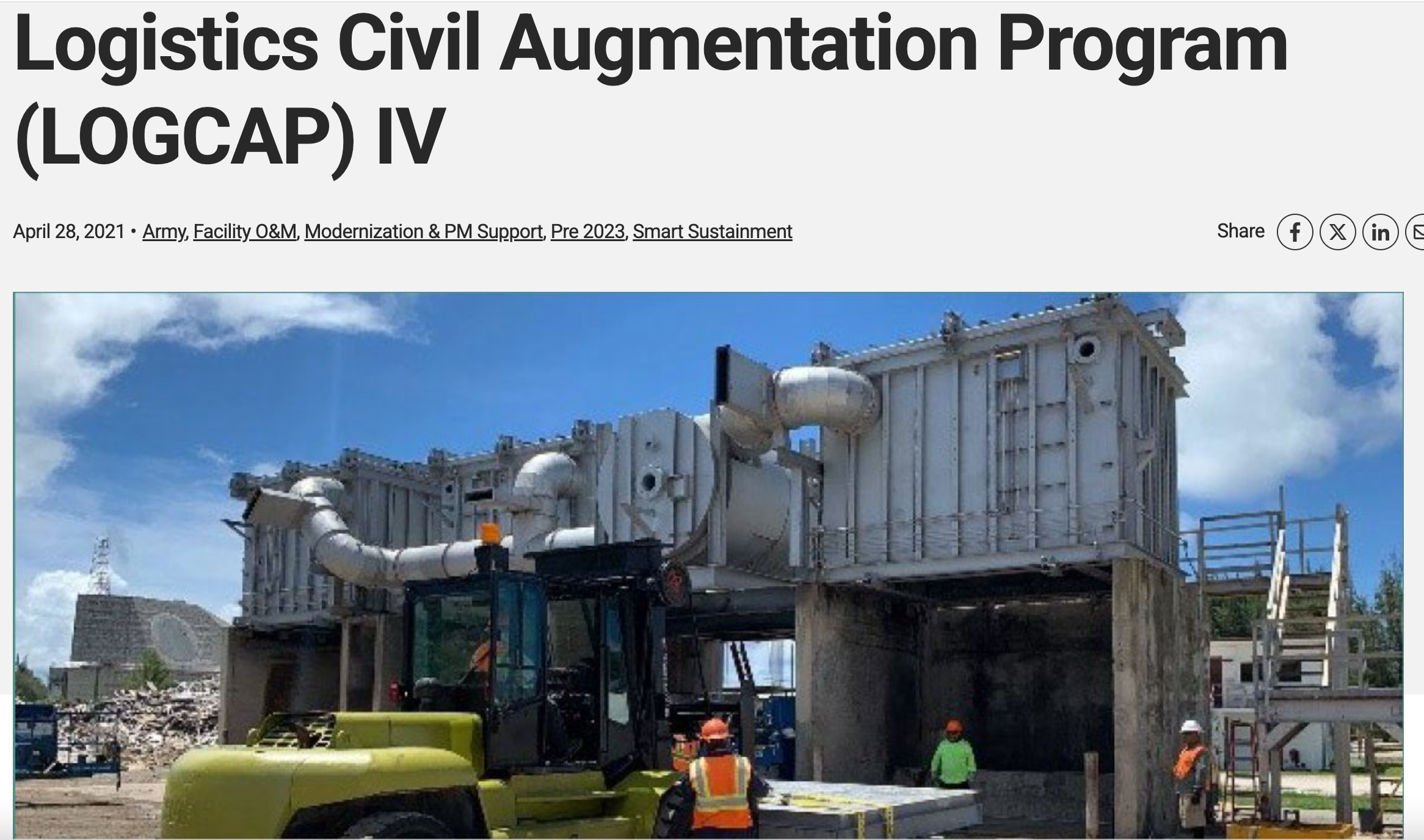 Amentum Provides Supply & Field Operations and Engineering & Construction Support Under LOGCAP Under the U.S. Army’s Logistics Civil Augmentation Program (LOGCAP) IV indefinite delivery/indefinite quantity (IDIQ) contract, Amentum, under its legacy company DynCorp International, provides a broad range of support services for U.S. and allied forces during combat, peacekeeping, humanitarian, and training operations. Our services include supply operations, such as the delivery of food, water, fuel, spare parts, and other items; field operations, such as facilities, housing, sanitation, waste management, postal services, and morale, welfare and recreation activities; and other operations, including engineering and construction, support to communication networks, transportation and cargo services, vehicle maintenance, and facilities maintenance and repair. Amentum has supported the LOGCAP IV program since 2008 through multiple task order awards, and maintains a Program Management Office in Fort Worth, TX to oversee program performance. https://www.amentum.com/project/logistics-civil-augmentation-program-logcap-iv/
Save
Cancel
2
bumps
Share
Signature
Loading…
Verify locally
Close