soj.ooO
BETA
The social discussion platform
Home
Pochas
Channels
Videos
Log in
Sign up
Sign up
Home
Pochas
Channels
Videos
Log in
Sign up
Parent Post: "Advancements" in modern medicine
·
In Reply To
carp30mnia
·
9/10/2025, 2:25:50 PM
·
permalink
Nah, skepticism is good and healthy for science. Open discussion builds trust and drives progress, while silencing people who question vaccines is **dogma**, not science. Blanket censorship only fuels suspicion and reduces oversight of mainstream science. And not all vaccines are the same — they differ in ingredients, formulations, mechanisms, and purposes. 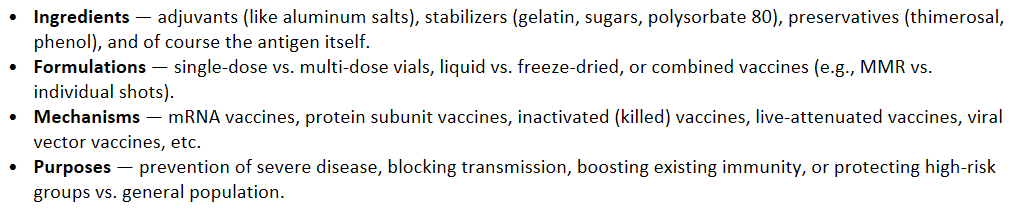 Some concerns focus on specific ingredients (i.e. aluminum salts) or mechanisms (i.e. mRNA), not on vaccination as a whole. Others worry how vaccines can effect virus evolution if done improperly. Example: **“Leaky” vaccines (stops symptoms, not disease from spreading) can actually drive viruses to evolve into deadlier forms, as happened with Marek’s disease in chickens.** Also people face different medical circumstances, allergies, and risk–benefit calculations. There can be religious reasons as well (ex: some vaccines use pig-derived gelatin as a stabilizer, some Muslims might consider this haram). If we silence every skeptical person, we risk fueling distrust and missing real opportunities to improve safety. Critical questions — even uncomfortable ones — have historically led to medical improvements (such as better testing protocols, clearer allergen labeling, and the removal of thimerosal). Shutting down opposing views doesn’t make medicine safer; open scrutiny does. If that means tolerating the whackier conspiracy theories, I don't mind. Oppositely, %%blind faith in *human-led* science getting everything right all the time is more questionable%%. While vaccines imo overall have saved lives, there have been real historical cases where things went wrong and caused harm. These are rare but often cited as reasons for caution. Here are some documented examples: 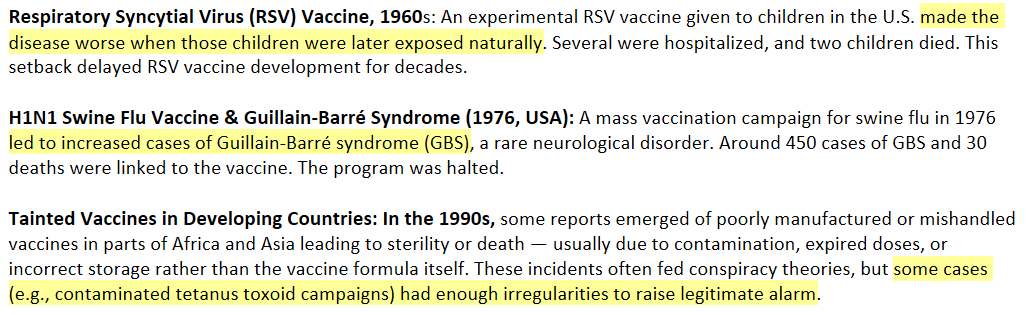 Vaccine-related accidents and failures have happened, and absolutely can happen again. These examples show why people can be skeptical, not necessarily of the idea of vaccination, but of implementation, oversight, and specific vaccines. It's why rigorous safety testing and transparency are essential. And that starts with being cautious and asking questions.
Save
Cancel
5
bumps
Share
Signature
Loading…
Verify locally
Close